
B2B Content Strategy Essential Lead Generation Elements
Why Your Content Isn’t Generating Leads
You’re publishing. You create blog posts, social updates, and maybe a newsletter. But the leads aren’t showing up, and you’re starting to wonder if content marketing was oversold to you in the first place.
It probably wasn’t. What’s more likely is that you have content, but you don’t have a B2B content strategy behind it. Those are two different things, and the gap between them is exactly where your leads are disappearing.
The Problem Is Strategy not Content
A business owner or marketing leader commits to “doing content,” assigns someone to write it, and measures success by whether something got published. Publishing becomes the goal instead of the means to increasing lead generation. The purpose got lost in the details of the process.
The trouble is, volume and value aren’t the same thing. You can publish every week for a year and still not move the needle if each piece exists in isolation. When content is disconnected from your audience’s actual questions, your sales process, and what happens after someone reads it, it goes nowhere.
To deliver content that generates leads, the content itself may be perfectly adequate, insightful, or even a pure expression of expertise, but it needs a place in the matrix. The failure point, if any, is likely upstream. There has to be a B2B content strategy connecting what you publish to what you’re trying to accomplish.
What an Effective B2B Content Strategy Includes
An effective B2B content strategy combines content campaigns, inbound funnels, and sales objectives. It’s a collaboration between marketing and sales teams. A working B2B content strategy isn’t a content calendar. It’s a system, and it has a few non-negotiable parts:
- Audience clarity—you know who you’re writing for, what they’re worried about, and where they are in their decision process.
- Funnel mapping—every piece of content has a job to do, whether that’s attracting attention, building trust, or moving someone toward a decision.
- Distribution—a plan for how content reaches the right people, not just where it gets posted.
- Measurement—defined signals of success beyond “we published it.”
With these four pieces in place, content creation becomes a strategy instead of an activity. You’re producing assets, not building a system. And systems are what generate leads. Individual pieces of content rarely do it alone.
Connecting Content to Lead Generation
This is where most teams lose the thread. They treat content marketing for lead generation as something that happens automatically once there’s enough content. It doesn’t. In other cases, it’s the sales team alone generating content, without reference to marketing’s objectives. It causes a disconnect between marketing spend and lead-generation outcomes. Lead generation works best when it’s approached holistically. When sales and marketing work together in a B2B content strategy, content spending matches each funnel stage.
- Top-of-funnel content should attract attention by addressing a real problem your audience is searching for answers to.
- Middle-of-funnel content should build credibility and trust. It shows proof that you understand their situation and have a way through it.
- Bottom-of-funnel content should make the next step obvious, whether that’s a consultation, a demo, or a downloadable resource that goes deeper.
When content lacks that alignment, you end up with pieces that read well but don’t move anyone forward. They inform without converting. Tracking which stage each asset serves—and measuring performance against that specific job—is what turns content output into a measurable pipeline contributor instead of a guess.
Content as Inbound and Sales Enablement Together
Content strategy doesn’t stop at the marketing handoff. Two areas are easy to overlook, and both matter if you want content to actually generate leads rather than just traffic.
The first is an inbound marketing content strategy—using content as the mechanism that draws prospects to you rather than chasing them down. This is foundational, well-established work. It’s also evolving: answer engine optimization (AEO) is emerging as a newer layer of inbound, as more search behavior shifts toward AI-generated answers rather than traditional results pages. It’s early, but it’s worth knowing the term and watching how it develops.
The second is B2B sales enablement content—material built specifically to support your sales process once a lead is qualified. Case studies, comparison guides, and objection-handling resources fall under this category. This is the piece most businesses skip entirely, treating content as a marketing-only function. But content that helps your sales conversations close faster is just as much a lead generation asset as the blog post that first attracted the visitor.
A real strategy accounts for both ends. It draws people in and helps your team close once they arrive. Both marketing and sales play a role in defining what to create in your B2B content strategy.
Building Your Own Content Strategy Checklist
If you want a quick gut check on where your content strategy actually stands, work through this B2B content marketing strategy checklist:
- Do you know which persona or audience segment each piece of content is written for?
- Is every piece of content assigned to a specific funnel stage — attract, engage, or delight?
- Do you have a distribution plan beyond “post it and hope”?
- Are you measuring content performance against business outcomes, not just views or likes?
- Does your content support your sales team after the marketing handoff, not just before it?
If you answered no to two or more of these, that’s not a content problem. That’s a strategy gap. The good news is that the gap is fixable.
Stop Guessing, Start Building a Plan
Content doesn’t underperform because it’s poorly written or infrequent. It underperforms because it’s disconnected from a strategy aligned with your actual business goals. Strategy works best when you do the work and build trust with your audience.
If your content hits big numbers but isn’t converting, remember: it’s not about reach or getting the biggest numbers. It is about reaching the right people at the right time. Having an integrated B2B content strategy that demonstrates your authority gives you the tools to do that. It builds the trust that grows your audience and drives the most value in lead generation. Fix the strategy, and the content you’re already capable of producing starts working a lot harder for you.
If you’re ready to stop guessing and start building a documented B2B content strategy that actually drives leads, our eBook Stop Wasting Marketing Dollars, which is the featured offer below, walks through exactly how to get there.
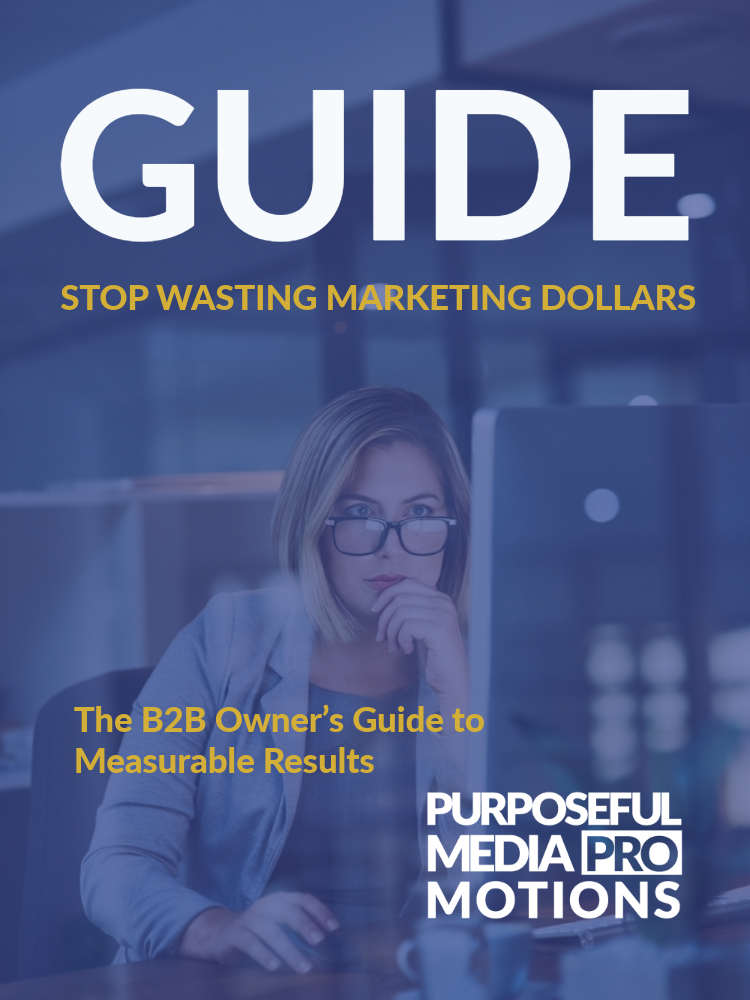
Most B2B owners know their marketing costs money. Far fewer know whether it’s actually working. Stop Wasting Marketing Dollars gives you a practical way to measure the impact of your marketing. It also helps you cut what does not work. You’ll learn how to connect your content, campaigns, and channels to real business outcomes, so every dollar you spend has a defensible return. If you’ve ever wondered whether your marketing investment is paying off, this guide was written for you.